When I first met Michele Metta he wanted to collaborate on a documentary we were making with Ken Loach. He was already well known for his investigation into the Kennedy assassination. What follows is an interview Michele did that has been published in Italy and now here in the UK.
https://youtu.be/wInUkNXCctk?is=CCn9aHOKcgbfIrcI
“Zionism as a state ideology must be consigned to the garbage heap of history.” – An interview with Omer Bartov – By Michele Metta –
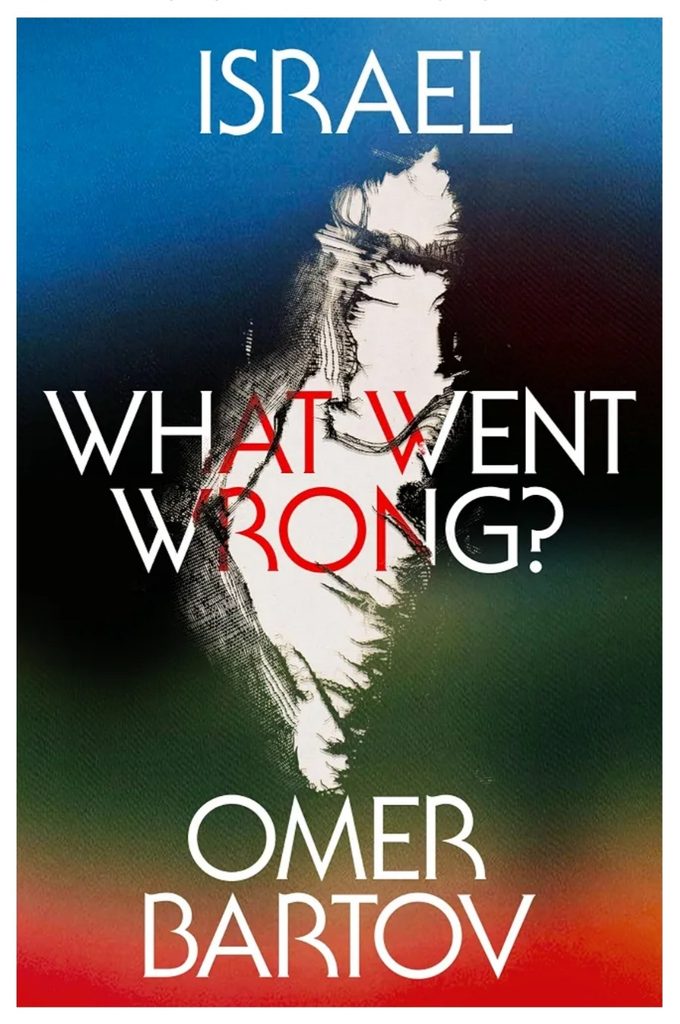
In my view, one of life’s most profound privileges occurs when, having entered a bookshop by chance, we emerge holding a literary treasure. This was precisely my experience when I purchased the latest volume by Omer Bartov, an intellectual of immense stature. I highly recommend this work, as it offers readers not only one of the most compelling, poignant, and significant books of 2026, but indeed of any historical era. In this case, we are dealing with non-fiction of a historical nature. Bartov demonstrates the ability to engage in rigorous self-reflection with extraordinary intellectual honesty, producing a volume that unequivocally denounces the genocide perpetrated by the Israeli government against the Palestinians. Moreover, since intellectual honesty is notoriously inconvenient– as the author himself noted in an interview with the Israeli newspaper Haaretz (Etan Nechin, ‘Zionism Led to Genocide. It Must Disappear’: Omer Bartov’s New Book Explores Where, Exactly, Israel Went Wrong, 24 April 2026)—his manuscript was rejected by numerous publishers.
https://www.amazon.com/Israel-What-Wrong-Omer-Bartov/dp/0374618186
This fact alone is an even more compelling reason to acquire the work, now that it is available in Italy, published by Laterza as Nell’abisso, with a title quite different from the original, Israel: What Went Wrong?. Prompted by my reading, I requested an interview, which he, with characteristic generosity, immediately granted. This allowed me to engage in dialogue with a scholar whose conversation is exceptionally pleasant and enriching, even when perspectives differ on certain aspects of Israel’s past. As will become apparent, Bartov, for example, interprets Ben-Gurion’s statecraft and the foundations of Israel through the lens of secular, pragmatic nationalism; I, by contrast, informed by the scholarship of Michael Karpin, David Ohana, Idith Zertal, and others, tend to discern a more dogmatic undercurrent. I have also written these introductory words to express my gratitude to him for this exchange of perspectives. With that, it is time to conclude this brief preamble and present the interview. I trust you will find the reading rewarding and that it will provide you with an additional reason to acquire his book.
MICHELE METTA: In your latest book, and through public interventions, you have openly stated that the actions of the Israeli government in Gaza constitute genocide. For an Israeli historian and scholar of your stature, this is a powerful act of moral courage and intellectual honesty, especially knowing that such a position would face severe backlash within Israel. What was the internal turning point or moral imperative that compelled you to speak out so clearly and unequivocally, despite the professional and personal costs?
OMER BARTOV: I had warned in a New York Times op-ed in early November 2023 that Israel was already engaging in war crimes and likely crimes against humanity in Gaza, because by that time, about 4 weeks after the Hamas attack of October 7, over 10,000 Palestinians, most of them civilians, had been killed. I also pointed out that Israeli political and military leaders had made statements indicating a genocidal intent in the immediate aftermath of the attack by Hamas. By May 2024 it became increasingly clear to me that the pattern of operations by the IDF indicated that it was acting in accordance with those statements, namely, that it was deliberately and systematically destroying everything in Gaza that would make it possible for the population to live there and to subsequently reconstitute itself as a group. These actions reached the high bar of the 1948 UN Convention of the prevention and punishment of the crimes of genocide, which it describes them as acts committed with the intent to destroy, in whole or in part, a national, ethnic, racial, or religious group. Such acts include killing members of the group, causing serious physical and mental harm to the group, creating conditions that would threaten the existence of the group, and preventing births within the group, all of which can now be ascribed to Israeli actions against Palestinians in Gaza.
MM: At the beginning of your book, you share a moving memory of your beloved father, who spent his final years warning that Benjamin Netanyahu was a disastrous danger to Israel. Today, the relevance of those prophetic words is increasingly clear. In your view, what concrete political actions or international pressures are now necessary to halt the current Israeli Prime Minister’s trajectory?
OB: The international community, and most importantly the US and Israel’s European allies, need to impose on it a series of economic, military, and political sanctions that will coerce it to abandon its current policies of destruction, annexation, population displacement, ethnic cleansing, and genocide, which are being conducted currently in Gaza, the West Bank, and Southern Lebanon. Israel cannot pursue such policies without close support from its allies. The US provides it with vast amounts of armaments, financial support, and political cover, aided by its veto power in the security council and its general ability to intimidate other countries wishing to sanction Israel. The EU is Israel’s largest trade partner and it also has a vast network of mutual military and technological interaction with Israel. Germany is Israel’s second largest arms supplies, and vast amounts of EU grants finance Israeli scientific and scholarly research. Only severe sanctions will make Israel redefine its political paradigm, which is currently based on use of sheer military force and oppression to try and take over territory in the West Bank and Gaza and remove or debilitate the Palestinian population living there.
MM: While international scholars like yourself are speaking out clearly, much of the Western and Italian mainstream media landscape –including prominent figures such as Enrico Mentana– remains highly hesitant, if not hostile, to using the term “genocide” to describe what the Israeli government is doing to the Palestinian people. What would you say to those Western journalists and commentators who seem to require an absolute, ultimate apocalypse before acknowledging what is unfolding in Gaza? What are the moral and professional responsibilities of the press in this specific historical moment?
OB: The obligation of politicians in countries that are signatories of the genocide convention is to abide by their country’s obligation to prevent and punish the crime of genocide. The obligation of the media is the report the fact as they are without fear or favor. It is known that Israel has a great deal of influence in terms of arms purchases and sales as well as technology, and that sensitivities about Israel, because of the events of the Holocaust, are still significant. But if Italy wants to help Israel become again, or for the first time, a real functioning democracy offering equality and dignity to all its citizens, it needs to identify its crimes and apply all the pressure it can for the good not only of Palestinians but also of Israelis. And the media must do its job to portray these crimes despite its reluctance to expose the public to these horrors — and not submit to the lies and obfuscations of Hasbara, the Hebrew word for the Israeli government propaganda machine.
MM: At one point in your book, you recall the brutal military campaign of total annihilation waged by the Israelis against the entire Gaza Strip, noting that, at the time of writing, 68,000 Palestinians had lost their lives, around 80% of whom were civilians, the majority being children. A few pages later, your horror is evident as you witness the Israeli leadership inflame the situation by suggesting that the most appropriate response to the Hamas attack is to follow what Deuteronomy invoked to avenge the attack against the Hebrews by the Amalekites, an ancient biblical nation living near the land of Canaan: an exhortation to kill all Palestinian “men and women, children and infants”. Elsewhere, with poignant lyricism, you observe that precisely because Israel was founded in the wake of the Holocaust to the cry of ‘never again’, what President Biden should have said when he still had the chance to stop the killings in Gaza, what Trump should have said, and what the leaders of the Jewish community and all other US communities should have said, above all the researchers and directors of institutions dedicated to the study and remembrance of the Holocaust, is this: “‘Never again’ means never again killing innocent Jews, as Hamas has done, just as much as it means never again killing innocent Palestinians, as the IDF has done by killing thousands of Palestinian children.” Do you think the United States will have the courage to elect a leader capable of uttering these words? Do you think Israel will have that same courage?
OB: I think it is not unlikely that the US will elect a president, either Democratic or Republican, who will distance the US from Israel to a larger extent than in previous decades. This is because American public opinion vis-a-vis Israel is changing dramatically. The liberal side is exasperated with Israeli crimes and the impact of the Jewish lobby. The Republican side, especially the MAGA movement, feels that Israel has been manipulating US policies and, invoking antisemitic arguments, that “the Jews” are controlling American policies, finance, and free speech. Israel has managed to produce an anti-Israel (and to some extent an antisemitic) wave, therefore, on both sides of the political spectrum.
MM: In your book, you also address a crucial point: the out-of-mind strategy pursued by Prime Minister Netanyahu over the years, which effectively allowed funds to reach Hamas. Please elaborate further on this accusation. In your view, to what extent does hypocritical amorality manifest in an Israeli political leader when fostering Hamas’s position in Gaza, and how did this policy ultimately contribute to the current catastrophe?
OB: Netanyahu’s policy over the years leading up to 7 October was to ‘manage the occupation’. This meant periodically resorting to what Israeli military leaders cynically call the strategy of ‘mowing the lawn’: that is, intervening every two or three years in Gaza with targeted bombings to reduce and contain, but not destroy, Hamas’s military capabilities. These incursions targeted identified or suspected manufacturing workshops or command posts, but, because of the Israeli Prime Minister’s cynical political calculus, rather than achieving real eradication of terrorists, they instead resulted in much larger operations in which ever more civilians were killed, as in 2014. This policy was based on the argument that Hamas was an “asset” because Israel could claim that its extremism prevented any reconciliation with Palestinians. Hence, at the same time, Israel agreed to channel to Hamas millions of dollars from Qatar. The policy blew up on Oct 7, as a result of which the Israeli government chose a policy of ethnic cleansing of Gaza so as to “solve” the problem once and for all. This policy also failed, leading instead to genocide, i.e. making Gaza uninhabitable to its population even as it could not actually leave the Strip.
MM: Your entire book is excellent. However, if I had to choose the parts that impressed and intrigued me most, one would certainly be the chapter in which you explain what happened after the United Nations General Assembly adopted, on 29 November 1947, the plan drafted by the United Nations Special Committee on Palestine (UNSCOP) to replace the British Mandate with a partition of the territory under Resolution 181. You highlight that this resolution not only recommended the creation of two independent states, one Jewish and one Arab, and an extraterritorial special international regime for Jerusalem and its surroundings, but also called for the adoption of a constitution in each state. However, you add that Israel still does not have a constitution today, and that to understand why Israel, once established as an independent state, has regressed to the point where its current government is accused of genocide, it is necessary to examine in detail the reasons the commitment to adopt an official written constitution was never fulfilled. You also add that another fundamental key to understanding Israel’s current regression lies in the way Ben-Gurion decided Israel’s Declaration of Independence should be written, requesting and obtaining the removal of the definition of Israel as a democratic nation –an amputation occurred without any opposition to his wishes. Would you return to your argument for our readers?
OB: It is extraordinary that although Israel has represented itself to the world and to its own citizens as both democratic and Jewish, it never actually managed to be both. Ben-Gurion opposed a constitution because it would have set constraints on the government and defined the borders of the state. It would have created a legal framework whereby Palestinians would have become equal citizens with equal rights. Not having a constitution meant that the state never had to define its borders or its relations with the Palestinians. The proclamation of the state, known in Israel as the Declaration of Independence, called it a Jewish state but not a democratic one, and as far as Palestinian citizens were concerned, they never enjoyed full democracy. Only in the basic laws of 1992 was the state described officially as Jewish and democratic. But the basic law of 2018, which defined Israel as the nation-state of the Jews, relegated Palestinians to second-class citizens.
MM: In the same chapter, you explain how Ben-Gurion removed all references to Israel’s borders from the final draft of the Declaration of Independence. In April 1948, the renowned jurist Hersch Lauterpacht described the future State of Israel in a draft as existing within the borders approved by the United Nations General Assembly, namely those established in the partition of 29 November 1947. However, during a debate within the Israeli provisional government, David Ben-Gurion rejected Lauterpacht’s proposal, stating that they were free to omit mention of the borders. And when Pinchas Rosen, a jurist and future Minister of Justice, and Bechor Sheetrit, another jurist and future Minister of Police and Minorities, argued that mentioning the borders was an unavoidable legal obligation, Ben-Gurion, after echoing King Louis XIV of France’s egotistical declaration, “I am the State”, by asserting that law is whatever people decide it is, instead of listening to reason, vehemently asked what would happen if Israel won a war or conquered western Galilee and both sides of the road to Jerusalem and, having the power to do so, all of this became part of the State. Do you not believe that these circumstances clearly indicate that the State of Israel was founded on the fanatical religious dogma that God had promised all of Palestine to the Jewish people?
OB: The declaration by Ben Gurion was pragmatic, not fanatic, and in fact was also, strictly speaking, legally correct, since state proclamations don’t necessarily define the borders of states. The US Declaration of Independence also did not define the US borders. This also had nothing to do with religion. Ben Gurion was hoping that the state could be larger than the borders allotted to it in the partition resolution. This was part of a nationalist Zionist conception that the Jews in Palestine should try to get as much land as they could, based on the belief that all of the land belonged to them. This was considered to be a historically justified claim since a Jewish state had existed in that land in antiquity. So we are speaking here of territorial nationalism. To be sure, there was reliance on the bible, but more as a book telling the history of the Israelites than as a religious text. Remember that the vast majority of Zionist leaders at the time were secular and mostly socialist.
MM: Let us continue discussing religious fanaticism. This year, there has been a deeply worrying increase in attacks by both Israeli settlers and soldiers on Christian communities, clergy, and holy sites in Jerusalem and the West Bank. This situation appears to reflect a wider global trend in which right-wing populist forces –most notably Donald Trump– have openly targeted religious authorities such as Pope Francis and his successor, Pope Leo, when they advocate peace and human rights. Do you consider these actions evidence of a growing, radical religious fanaticism within Israeli society that regards all non-Jewish faiths and universalist leaders as existential enemies?
OB: There is a growing religious fanaticism of Jews in Israel today among the settlers and the national religious movement. Indeed, Judaism is transforming in Israel into a Jewish supremacist faith linked to a transformed religious and violent Zionism. It is very different from both Judaism as it existed in the past and from socialist Zionism at the time of Ben Gurion, and it is creating a rift between the Jewish Diaspora and Israel as well as eroding whatever is left of Israeli democracy and liberalism even for the state’s Jewish citizens. In the US, Trump is of course anything but a religious fanatic. But among his supporters there is a growing force of Christian nationalism which is intolerant of other religions and envisions a white Christian America and white Christian global rule — and is therefore also racist.
MM: Looking back at historical precedents, President John F. Kennedy famously clashed with the Israeli leadership over the Dimona nuclear facility, as he opposed the development of an Israeli nuclear arsenal, viewing it as destabilising for the Middle East and an obstacle to global disarmament. Today, while the Iranian nuclear programme is debated as something to stop at any cost, Israel’s actual possession of nuclear weapons and the threat this poses remain an absolute taboo in mainstream discourse. In hindsight, do you believe Kennedy was right in his warnings, and how does this enduring nuclear taboo affect the balance of power and the prospects for lasting peace in the region?
OB: The nuclear program in Israel was originally perceived, I believe, as providing Israel with a last-minute military option in case its existence was threatened, at a time when it was still a much weaker and militarily more threatened state. The experiences of Libya and Ukraine have shown that small/medium-sized states can only protect themselves from attacks by larger states by having nuclear arms. I suspect that as soon as the war in Iran is over, Iran will realize its ambition of having a nuclear bomb as the only guarantee against attacks by the US and Israel. The problem with this policy is the danger of nuclear proliferation. But pragmatically, in a world that increasingly disdains international norms, having the Bomb is the best guarantee against foreign invasion/intervention.
MM: Turning to another deeply concerning aspect of the current Israeli establishment, much attention has focused on the overlapping networks of international finance and political influence, such as the documented connections between figures like Jeffrey Epstein and high-ranking Israeli politicians, and the rise of advanced military technology corporations like Palantir, which now actively supports Israeli defence operations. How do you view this convergence of unaccountable global networks and technology-driven warfare, and how does it complicate the prospect of achieving accountability and justice for the Palestinian people?
OB: There are obviously numerous financial, military, and technological networks involved in what we are seeing now in Israel/Palestine, Russia/Ukraine, etc. One reason for the lack of criticism of Israeli policies in Europe is the dependence of European states on Israeli military technology even as they are also selling arms and technology to Israel. Politicians who depend on funds for their campaigns and/or are invested in lining their pockets with money from military industries are loath to condemn such countries as Israel making, selling, and buying such technologies. The other problem is the predilection to define such networks, because of the possible engagement in them of such people as Epstein, as some sort of Jewish conspiracy or hidden power. That is nonsense. Israel as a state, and some rich Jewish supporters and businessmen, may well engage in criminal acts, but that should not reflect on Jews in general.
MM: Jewish scientist Albert Einstein, along with several other prominent Jewish intellectuals, including Hannah Arendt, Nachman Maisel, and Sidney Hook, signed an open letter to the editors of the New York Times in December 1948. They described the Irgun as “a terrorist, right-wing, chauvinist organization in Palestine” and Herut, the Israeli reactionary political party formed by the Irgun, as “akin in its organization, methods, political philosophy and social appeal to the Nazi and Fascist parties.” What is your opinion of the content of this letter?
OB: They were generally right though I’d say that the Irgun was closer to fascism than to Nazism since it was generally not racist or genocidal — as Zionism has become in recent years.
MM: On 10 November 1975, by 72 votes in favour, 35 against –including the United States, Israel, and Western European countries– and 32 abstentions, the United Nations General Assembly adopted Resolution 3379, declaring Zionism to be a form of racism. During this session, the Israeli Ambassador to the UN, Chaim Herzog, who later became President of Israel, delivered a notable speech condemning the resolution and symbolically tore up its text at the podium. Sixteen years later, on 16 December 1991, by 111 votes in favour, 25 against, and 13 abstentions, the UN General Assembly adopted Resolution 46/86, which had a single, brief objective: to revoke Resolution 3379. This was one of the very few instances in United Nations history where a General Assembly resolution was explicitly repealed and overturned. My question is: In light of current events, which do you regard as the graver error –the adoption of the resolution, or its subsequent full repeal without consideration of a middle ground?
OB: I don’t think Zionism at its inception or even in 1975 as any more racist than many other ethno-nationalist ideologies — that is, it was violent against those it perceived as its enemies, especially Palestinians, but generally did not adhere to biological racism. In the decades that have passed since, it has become increasingly racist, largely as a result of the ongoing and ever more violent occupation, and has merged with a new type of Jewish-supremacist Judaism in an ideology that is akin to other genocidal and racist ideologies that have no legitimacy to be recognized by the international community. Hence my conclusion that though the state of Israel has a right to exist, like all other states, as long as it does not oppress its inhabitants and practice violence against those it rules, Zionism as a state ideology must be consigned to the garbage heap of history.
Interview by Michele Metta